
Five days is not much time for a country that has been collecting wonders for over five thousand years, but it is enough to see the very best of it. In under a week you can stand beside the last surviving wonder of the ancient world, walk among giant temple columns carved three millennia ago, and drift along the Nile while the desert glows orange at sunset. The secret is choosing the right route: Cairo for the pyramids and museums, then Luxor and Aswan for temples, tombs and river life. This guide shows you exactly what to see in Egypt in 5 days, how to organize each day, and how to avoid the mistakes that waste precious hours. If you prefer to have everything arranged for you, the 5-day Cairo and Nile cruise package follows a very similar flow.
Quick Facts: Egypt in 5 Days
| Quick Facts | Details |
|---|---|
| Route | Cairo, Luxor, Aswan (by flight and Nile cruise) |
| Trip length | 5 days / 4 nights |
| Best time to visit | October to April, when days are warm rather than scorching |
| Main highlights | Giza Pyramids, Sphinx, Egyptian antiquities, Karnak, Valley of the Kings, Philae Temple |
| UNESCO sites on route | Memphis and its Necropolis (Giza), Ancient Thebes (Luxor), Nubian Monuments (Philae) |
| Walking level | Moderate, with lots of standing and uneven ground |
| Tickets and hours | Vary by site and season, so confirm on the day of booking |
| Recommended style | Private guide or small-group tour to save time |
Why Visit Egypt for 5 Days?
- Unmatched history: nowhere else packs pyramids, temples and tombs so closely together.
- Efficiency: short domestic flights make Cairo, Luxor and Aswan easy to link.
- Variety: busy city markets, silent desert plateaus and peaceful river scenery in one trip.
- Photography: golden-hour light on stone is simply spectacular.
- Comfort: a Nile cruise lets you sleep, eat and travel in one place, so you unpack only once.
- Good value: a guided short trip removes the guesswork about tickets, transfers and queues.
A Brief History Behind What You’ll See
Understanding the timeline makes every stop more meaningful, so here is the short version. Around 2600 BC, pharaohs of the Old Kingdom began building monumental tombs near modern Cairo. The Great Pyramid of Khufu, finished around 2560 BC, remained the tallest human-made structure on Earth for nearly four thousand years. Later, during the New Kingdom (roughly 1550 to 1070 BC), Egypt’s capital moved south to Thebes, today’s Luxor. Kings such as Hatshepsut, Thutmose III, Amenhotep III and Ramses II filled the area with temples, while royal burials were hidden in desert valleys on the west bank. Far to the south, Aswan guarded Egypt’s border and quarried the granite used for obelisks and statues. When Greeks and Romans later ruled Egypt, they added new temples, such as Edfu and Philae, dedicated to the old gods.
So in five days you effectively travel through the whole story: tombs of the first great builders in Cairo, then the religious and royal heartland in Luxor, and finally the frontier city of Aswan.
What to Expect on a 5-Day Egypt Trip
The pace. Days start early. Many sites are quietest in the first hour after opening, and the midday sun can be intense even in winter. Expect a morning of sightseeing, a long lunch, and a lighter afternoon.
Crowds. Giza and Karnak are the busiest. Arriving at opening time, or visiting late afternoon, makes the experience much calmer. Weekends and school holidays are heavier.
Distances. Cairo is spread out and traffic is heavy, so allow generous time for transfers. In Luxor, the East Bank (Karnak, Luxor Temple) and West Bank (tombs and mortuary temples) are separated by the Nile, usually crossed by bridge or ferry.
Weather. From November to March, daytime temperatures are usually pleasant, with cooler evenings. Summer can be extremely hot, especially in Upper Egypt, so schedule outdoor visits at dawn.
Accessibility. Many ancient sites involve steps, sand and uneven stone, so wheelchair access is limited at some locations. Major attractions have toilets and cafés nearby, and families with children usually enjoy the pyramids and boat rides. If mobility is a concern, ask your operator in advance about electric carts, vehicles that drive close to entrances, and which tombs are easiest to enter.
Your 5-Day Egypt Itinerary
Day 1: Cairo Arrival and the Pyramids of Giza
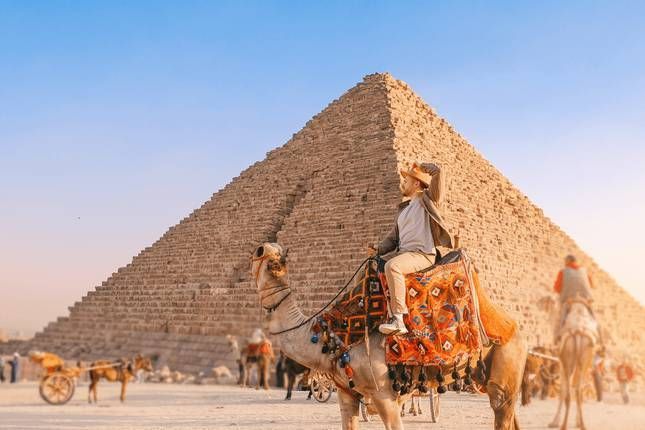
Begin where every Egypt journey should: the Giza Plateau. If your flight lands in the morning, drop your bags and head straight there. The Great Pyramid of Khufu dominates the skyline, flanked by the pyramids of Khafre and Menkaure. Walk around the base to feel the scale of the limestone blocks, many taller than a person’s waist. If you are comfortable in tight spaces, you can purchase a separate ticket to enter one pyramid, though the narrow passage is not for everyone.
Next, visit the Great Sphinx, carved from a single outcrop of rock and guarding the valley below. For the best panoramic view of all three pyramids at once, stop at the plateau’s desert viewpoint, where you can also try a short camel or horse ride. In the evening, enjoy dinner by the Nile, then rest. Tomorrow starts early.
Day 2: Cairo Museums, Old Cairo and Khan el-Khalili
Spend the morning with Egypt’s most famous treasures. The Grand Egyptian Museum near the pyramids is designed to display the collection on a monumental scale, including the Tutankhamun galleries, while the older Egyptian Museum in Tahrir Square remains a classic for its dense, old-fashioned atmosphere. Choose one if time is limited, because a rushed double visit is exhausting. Check the current opening arrangements and which galleries are open before you go, since exhibits are reorganized over time.
After lunch, explore Old Cairo, where Coptic churches, the Hanging Church and a historic synagogue sit within a short walk of each other. It is a quiet counterpoint to the pyramids and shows how many faiths shaped the city. As the afternoon cools, wander the lanes of Khan el-Khalili bazaar. Shops sell spices, lanterns, brass, perfume bottles and hand-made jewelry. Bargain politely, accept tea if offered, and finish the day with a coffee at one of the old cafés
Day 3: Fly to Luxor and Explore Karnak and Luxor Temple
Take an early flight south to Luxor, often called the world’s greatest open-air museum. After checking in to your hotel or boarding your Nile cruise ship, go straight to Karnak Temple. This vast complex was expanded over some two thousand years. The headline attraction is the Great Hypostyle Hall, a forest of 134 enormous papyrus-shaped columns still covered in carved scenes. Look for the tall obelisk raised by Hatshepsut and the sacred lake where priests once purified themselves.
Return at sunset to Luxor Temple, linked to Karnak in ancient times by an avenue of sphinxes. Illuminated at night, its colossal statues and towering entrance are especially photogenic. This is the perfect place to slow down, as the temple is smaller and easier to enjoy than Karnak. If you are traveling on a cruise, this is also when your first sunset on the Nile arrives.
Day 4: Valley of the Kings, Hatshepsut Temple and Edfu

Cross to the West Bank at sunrise, when the light is soft and the sites are calm. The Valley of the Kings holds the burial chambers of pharaohs, including Ramses VI and Tutankhamun. A standard ticket usually covers three tombs, and some famous tombs need a separate ticket, so decide in advance which you prefer. The painted walls are astonishingly well preserved, and the colors still look bright after more than three thousand years. Photography rules inside tombs can change, so ask your guide before using a camera.
Next, visit the terraced Temple of Hatshepsut, set dramatically against golden cliffs. Built for one of Egypt’s few female pharaohs, its elegant colonnades look almost modern. Add a short stop at the Colossi of Memnon, two giant seated statues of Amenhotep III on the way back.
In the afternoon, if your route includes a cruise, the ship usually sails south, with the Temple of Horus at Edfu among the best-preserved temples in Egypt. Travel there by horse carriage and admire the huge gateway, courtyards and reliefs that tell the story of the falcon god. If you are on a faster land schedule, you can instead continue directly to Aswan by plane or road.

Day 5: Aswan, Philae Temple and a Felucca Ride
Aswan feels slower, greener and more relaxed than any other stop. Start at the Philae Temple, dedicated to the goddess Isis. It sits on an island and is reached by a short boat trip, one of the most memorable moments of the whole journey. The temple was relocated stone by stone to save it from rising water, and the effort itself is part of its fascinating story.
Then see the Unfinished Obelisk in the granite quarries, which would have been the largest ever carved if it had not cracked. Look at the High Dam as a modern engineering counterpart. Finish with a traditional felucca sail around Elephantine Island, drinking hibiscus tea while the breeze cools your face. If time remains, visit a Nubian village for colorful houses, local crafts and warm hospitality. Departing travelers can fly from Aswan directly back to Cairo or onward home.
Top Highlights You Shouldn’t Miss
- Great Pyramid of Khufu: the last survivor of the Seven Wonders of the Ancient World.
- The Sphinx: a lion-bodied guardian whose face still invites debate about its meaning.
- Tutankhamun treasures: the golden mask is one of the most recognizable objects on Earth.
- Karnak’s Hypostyle Hall: columns so large that a hundred people could stand on one capital.
- Valley of the Kings tombs: painted burial chambers that bring ancient beliefs to life.
- Philae Temple: pure atmosphere, especially in the soft light of the morning.
- A Nile sunset: free, simple, and impossible to forget.
Practical Travel Tips
- What to wear: light, breathable clothes that cover shoulders and knees, plus a hat and sunglasses. Comfortable closed shoes are essential because ground is dusty and uneven.
- What to bring: sunscreen, refillable water bottle, a small amount of cash in local currency for tips and snacks, and a portable charger.
- Photography tips: shoot early morning or late afternoon for warm light. Be aware that drones are restricted, and some tombs charge extra for camera use or prohibit it.
- Common mistakes: trying to fit in too much, visiting midday in summer, and accepting unsolicited “free” offers near the monuments. Politely say no and keep walking.
- Safety advice: use licensed guides, agree prices before taking rides, and drink bottled water. Follow your government’s up-to-date travel advice and your guide’s recommendations.
- Tipping: small tips are customary for guides, drivers and cruise staff, so keep small bills handy.
- Book early: popular cruise cabins and private guides are in highest demand from December to February.
How to Get There and Get Around
Most international visitors arrive at Cairo International Airport. From there, a pre-booked private transfer is the easiest option, as taxis and ride-hailing apps such as Uber are also widely used in the capital. Between cities, domestic flights from Cairo to Luxor and from Aswan back to Cairo save huge amounts of time, with each flight usually taking about an hour or so. Overnight trains and long road trips exist but are poorly suited to a five-day plan. In Luxor and Aswan, short distances are covered by private vehicle, calèche, local ferry or a pre-arranged tour. Walking works well inside the temples themselves but not between major sites. A fully organized program removes all these logistics, which is why many travelers choose a package like this Cairo and Nile cruise itinerary.
Nearby Attractions If You Have Extra Time
If you can extend the trip by a day or two, consider these additions:
- Saqqara and Memphis: the Step Pyramid is the oldest large stone building in the world.
- Dahshur: the Bent and Red Pyramids, much quieter than Giza.
- Abu Simbel: the colossal temples of Ramses II, reached from Aswan by an early-morning drive or short flight.
- Hot air balloon in Luxor: a sunrise flight over the West Bank is a once-in-a-lifetime view.
- Alexandria: a Mediterranean contrast with sea air and a Greco-Roman past.
You can browse more trip ideas on the Love Egypt Tours website.
Recommended Tours
Choosing the right format makes a five-day trip feel relaxed rather than rushed.
- Cairo and Nile cruise: combines the pyramids, museums and a river voyage in one smooth plan. See the 5-day Cairo and Nile cruise for the full itinerary.
- Luxor day tours: ideal if you are adding Luxor to a longer Egypt journey.
- Egypt tour packages: for travelers with a week or more, explore the wider Egypt tour collection.
Real Visitor Insights
Travelers frequently say that the combination of Cairo and a Nile cruise is the most relaxing way to see Egypt on a short schedule, because the ship handles hotels, meals and transport while the guide handles the storytelling. Many also mention that sunrise at the Valley of the Kings was the moment when the whole trip came together.
Frequently Asked Questions
Is 5 days enough to see Egypt? Yes, if you focus on the highlights. Five days comfortably covers the pyramids, a major museum, Luxor’s temples and tombs, and Aswan. You will not see everything, but you will experience the essentials.
What is the best time to visit Egypt? October through April is the most comfortable period, with December to February the busiest. Summer is possible but very hot in the south.
Is a guide recommended? Absolutely. A knowledgeable Egyptologist turns piles of stone into stories, handles tickets and queues, and keeps you away from pressure sellers.
Is it crowded? Giza, Karnak and the Valley of the Kings can be busy. Arriving right at opening time or late in the afternoon makes a big difference.
Can I buy tickets online? Many major sites and museums offer online or advance options, but availability varies. Tour operators normally include entrance fees or arrange them for you.
Is Egypt suitable for children? Yes. Children usually love camels, boats and the dramatic tombs. Bring hats, water and plenty of snacks, and keep the schedule flexible.
Can I take photos? Outdoors, yes. Inside some tombs and museums, cameras may be restricted or require a permit, so always check the rules at the entrance.
Should I choose a cruise or hotels? A cruise is convenient and scenic since you unpack only once. Hotels give more freedom for evening exploring. Both work well for a short trip.
Conclusion
Five days in Egypt is a compact adventure with a huge payoff. You begin with the awe of the pyramids and Sphinx, deepen the story with the treasures of Cairo, then move south to the temples and tombs of Luxor before ending peacefully on the water in Aswan. With early starts, comfortable clothing and a well-planned route, you will leave with memories that last far longer than the trip itself. Egypt rewards curiosity, and even a short visit will leave you planning your return.