
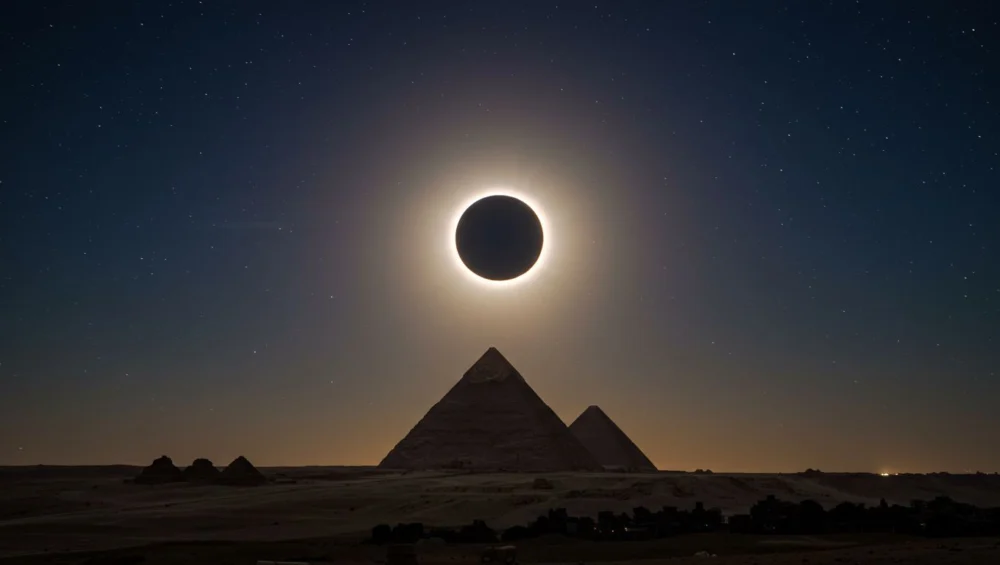
On August 2, 2027, Egypt will witness one of the most spectacular astronomical events of the 21st century — a total solar eclipse that will plunge parts of the country into a brief day-time darkness. Known by many as the “eclipse of the century,” this rare phenomenon promises an unforgettable experience for locals, tourists and sky-watchers from around the world.
This blog post takes you inside everything you need to know about the 2027 solar eclipse in Egypt — from timing and visibility to travel tips and safety. Let’s unpack this celestial show!
What Is a Solar Eclipse?
A solar eclipse occurs when the Moon passes directly between the Earth and the Sun, blocking part or all of the Sun’s light. When the Moon completely obscures the Sun’s disk, a total solar eclipse happens — turning day into night for a brief period. This spectacular alignment is not only mesmerising but also scientifically significant.
Total solar eclipses are relatively rare at any one location because the Moon’s shadow traces a narrow path across Earth’s surface. For most people, witnessing one in person happens perhaps once in a lifetime.
When and Where Will the Eclipse Occur?
Date & Time
-
Date: August 2, 2027
-
Peak Totality in Egypt: Around local noon
On this day, the Moon will pass perfectly in front of the Sun, casting its shadow over parts of Europe, Africa and the Middle East. In Egypt, the phenomenon will be most dramatic in specific regions, making it a global attraction.
Why Egypt Is a Prime Viewing Spot
Egypt has emerged as one of the best places in the world to experience the 2027 total solar eclipse, and there are several reasons for that:
1. Longest Duration of Totality
According to astronomical calculations, parts of Egypt — especially near Luxor — will experience totality lasting over six minutes (about 6 minutes 22-23 seconds). This duration is exceptionally long for a total eclipse and is expected to be longer than almost every other location on Earth for this event.
Longer totality means:
-
More time to observe the Sun’s corona (the outer atmosphere)
-
Greater chances for stunning photography
-
More immersive eclipse experience
This extended totality is due to the unique alignment of the Sun, Moon and Earth on that date.
Best Places in Egypt to Watch the Eclipse
Egypt’s geography plays a big role in how the eclipse will appear. Here are some of the top locations within the path of totality:
1. Luxor
Luxor lies very close to the centre of the Moon’s shadow path, giving it one of the longest durations of totality. This makes it the ultimate destination for eclipse lovers.
2. Sohag & Asyut
These cities also fall within the path and will enjoy a significant duration of total eclipse, offering excellent alternatives for viewing.
3. Red Sea Region (Berenice, Port Ghalib, Marsa Alam)
The eastern coast of Egypt will also witness the eclipse, with places like Berenice Troglodytica experiencing totality of over five to six minutes.
4. Other Cities (Partial Eclipse)
Cairo, Alexandria and much of northern Egypt will see a partial eclipse, where the Moon covers most — but not all — of the Sun. Though not total, the partial eclipse is still an incredible sight.
What You’ll See: From Partial to Total Eclipse
A solar eclipse has several stages:
1. Partial Phase Begins
Before totality, the Moon will gradually cover more of the Sun. This can last over an hour.
2. Totality
At the moment of totality, the Sun’s bright surface is completely covered, revealing the solar corona — the Sun’s outer atmosphere — as a glowing halo. The sky darkens as if twilight has arrived.
For the 2027 eclipse, totality will last nearly 6 minutes and 23 seconds in the best viewing areas, one of the longest in recent history.
3. End of Eclipse
After totality, the Moon continues moving, gradually uncovering the Sun until normal daylight resumes.
Scientific Importance of Solar Eclipses
Solar eclipses are not just scenic — they are important scientifically. During totality, astronomers can study the Sun’s corona, which is usually hidden by the Sun’s bright surface. These moments offer insight into solar winds, magnetic fields and space weather.
Eclipses also help scientists test theories about light and gravity, and study how the Earth’s atmosphere reacts to sudden changes in solar radiation.
Tourism and Egypt’s Eclipse Boom
Tour operators worldwide have already started planning special eclipse travel packages focused on Egypt for August 2027. Luxor, with its ancient temples and historical significance, is becoming the focal point of this once-in-a-century event.
Here’s why tourists are flocking:
-
Ancient backdrop: Imagine watching the eclipse near the Karnak Temple or Valley of the Kings.
-
Clear skies: Egypt’s desert climate in August offers a high chance of cloud-free conditions ideal for watching the eclipse.
-
Cultural experience: Combine astronomy with sightseeing — pyramids, Nile cruises, archaeological sites and festivals.
Hotels, Nile cruises and guided tours are already offering tailored experiences for eclipse viewers.
Weather and Sky Conditions
Egypt’s weather in early August is typically dry and sunny, making it a favorable destination for sky observation. While weather forecasts can never guarantee perfect conditions, the region’s desert climate gives it a good chance of clear views.
Nevertheless, it’s always wise to check local weather closer to the event and plan accordingly.
Safety Tips: Watching the Eclipse the Right Way
Observing a solar eclipse safely is crucial — looking directly at the Sun without protection can cause serious eye damage.
Here’s how to stay safe:
✔️ Use ISO-certified solar eclipse glasses to watch the partial phases.
✔️ Only remove glasses during totality, when the Sun is completely hidden.
✔️ Never look through binoculars, cameras or telescopes without a certified solar filter.
✔️ Regular sunglasses are NOT safe for eclipse viewing.
Following these guidelines ensures you can enjoy the eclipse without risking your eyesight.
Photography Tips
If you plan to photograph the eclipse:
-
Use a solar filter for cameras and telescopes.
-
Mount your camera on a tripod for stable shots.
-
Practice focusing on the Sun before the eclipse.
-
Consider wide-angle shots during totality to capture the environment and crowd reactions.
Photographing a solar eclipse is challenging but rewarding, especially with good planning and the right gear.
Frequently Asked Questions About the 2027 Eclipse
Is Egypt guaranteed to see the total eclipse?
Yes — parts of central and southern Egypt, especially near Luxor, will experience the total solar eclipse.
Will Cairo witness totality?
Cairo will see a partial eclipse, not full totality.
How long does the total eclipse last?
In the best locations, totality will last approximately 6 minutes and 22-23 seconds — one of the longest durations for any eclipse this century.
Why is this eclipse so important?
Because of its long duration, favorable viewing locations and broad path across populated regions, it’s considered one of the most significant celestial events of the decade.
Conclusion: An Unmissable Moment
The Solar Eclipse in Egypt 2027 is shaping up to be a once-in-a-lifetime experience. With Luxor and much of central Egypt in the path of totality, sky-watchers and tourists alike will have a rare opportunity to witness the Moon’s shadow darken the Sun against some of the world’s most ancient and enchanting landscapes.
Whether you’re a seasoned astronomer or a curious traveler, planning ahead will make this celestial spectacle an unforgettable part of your life story.
Mark your calendar: August 2, 2027 — when Egypt becomes the center of the universe.