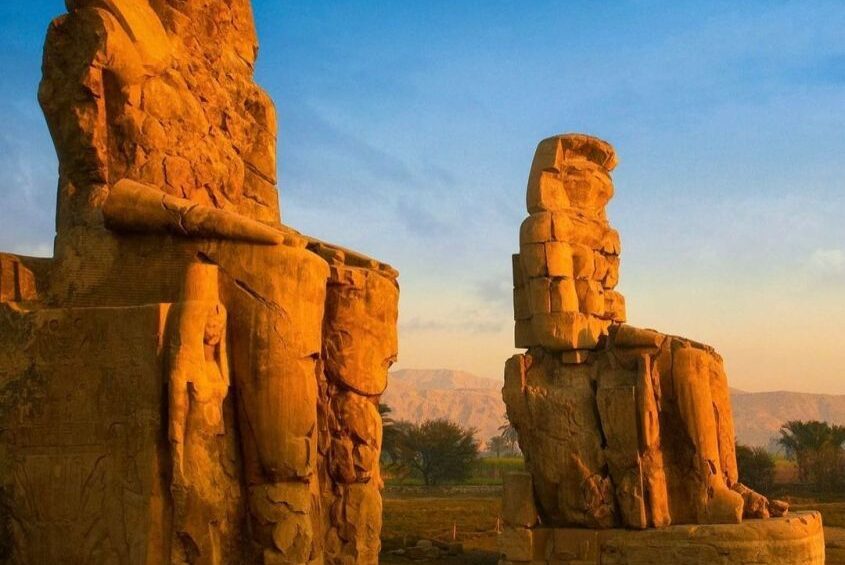
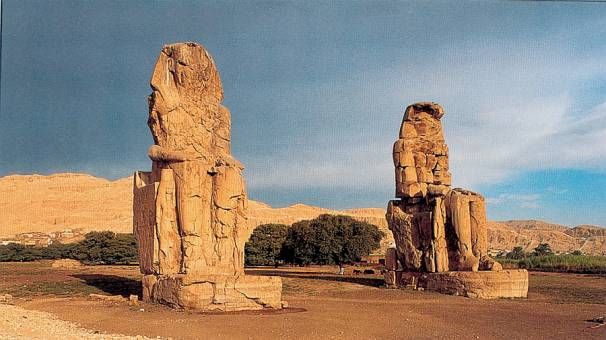
The Colossi of Memnon are two enormous stone statues located on the west bank of the Nile River, near Luxor, Egypt. These ancient monuments have stood for over 3,400 years and are among the most remarkable remnants of Ancient Egypt. Originally built to guard the mortuary temple of Pharaoh Amenhotep III of the 18th Dynasty, the Colossi of Memnon remain a must-visit attraction for travelers exploring the historical treasures of Luxor.
Decription of the Colossi of Memnon
Each statue stands approximately 18 meters (59 feet) tall and weighs around 720 tons. Carved from quartzite sandstone, the Colossi depict Pharaoh Amenhotep III seated on a throne, with his hands resting on his knees and his gaze facing east toward the Nile. The statues originally flanked the entrance of Amenhotep III’s massive mortuary temple, serving as guardians and symbols of his divine rule.
The intricate details on the statues include the nemes headdress, the uraeus (sacred cobra) on the forehead, and throne decorations depicting the Nile god Hapi. These artistic elements highlight the craftsmanship of ancient Egyptian artisans and the importance of the pharaoh’s connection to the Nile.
Historical Context
Amenhotep III and the New Kingdom
Pharaoh Amenhotep III reigned from approximately 1386 to 1349 BCE, during the height of Egypt’s New Kingdom, a period of immense wealth, power, and cultural achievement. He commissioned the mortuary temple in Luxor to honor his reign and ensure his eternal presence in the afterlife. The Colossi of Memnon, standing at the western approach, symbolized protection and grandeur.
The temple complex, originally spanning 35 hectares (86 acres), included courtyards, statues, obelisks, and colonnades. While much of the temple is now lost, the Colossi remain iconic, providing a glimpse into the scale and majesty of Amenhotep III’s architectural vision.
Construction Techniques
The statues were carved from quartzite blocks quarried near modern-day Cairo, over 420 miles (675 km) away. Transporting these massive stones required advanced engineering, likely involving sledges, ramps, and barges along the Nile. The precision in carving and assembling the Colossi reflects the sophistication of ancient Egyptian construction techniques.
Damage and Historical Legends
Over centuries, earthquakes and natural wear caused significant damage. The northern statue is famous for developing a crack in 27 BCE, during the Roman period, which produced a “singing” sound at sunrise. Greek and Roman visitors considered the phenomenon magical or prophetic. Repairs by Emperor Septimius Severus in the 3rd century CE eventually stopped the sound.
Cultural Significance
Religious Importance
In Ancient Egyptian culture, statues were more than art; they were vessels for the pharaoh’s ka (spirit). The Colossi of Memnon symbolized Amenhotep III’s eternal presence and divine connection, particularly to the Nile, Egypt’s life source.
Greco-Roman Interest
The “singing” phenomenon made the Colossi famous in the Greco-Roman world, with historians like Strabo and Pliny the Elder documenting their experiences. Pilgrims and tourists left inscriptions on the statues, many of which survive today, offering insights into historical travel and beliefs.
Modern Tourism
Today, the Colossi of Memnon are one of Luxor’s top tourist attractions. Visitors can walk around the statues, explore the remains of the mortuary temple, and appreciate the engineering and artistry of ancient Egyptian civilization. The site is often included in Egypt tours, making it an essential stop for anyone interested in history, culture, and archaeology.
Archaeological Studies
Modern archaeological efforts have uncovered parts of the mortuary temple, including statue fragments, reliefs, and obelisks. Studies of the Colossi provide insight into New Kingdom art, royal portraiture, and construction techniques. Technologies like 3D scanning and remote sensing allow researchers to study the statues’ stability and fine details without causing damage.
Conservation Efforts
Preserving the Colossi is challenging due to weathering, pollution, and seismic activity. Egyptian authorities, alongside international experts, work to stabilize the statues, prevent further cracks, and conserve the surrounding site. Protecting the Colossi ensures that future generations can witness these iconic symbols of Ancient Egypt.
Legacy and Importance
The Colossi of Memnon represent the grandeur of the New Kingdom and the enduring legacy of Egyptian art and engineering. They are a major attraction for historians, tourists, and cultural enthusiasts worldwide. Standing before the Colossi, visitors can experience a tangible connection to a civilization that thrived thousands of years ago.
Conclusion
If you want to explore the Colossi of Memnon, discover the wonders of Luxor, and experience the magic of Ancient Egypt, check out our Egypt tours. Travel with Love Egypt Tours, rated as one of the best on TripAdvisor, and enjoy an unforgettable journey through history, culture, and adventure.